Introduction
One of the most common challenges parents face when supporting a child with Autism Spectrum Disorder (ASD) is managing behaviour. Many parents describe situations where their child cries, throws objects, or refuses tasks, and they are unsure how to respond.
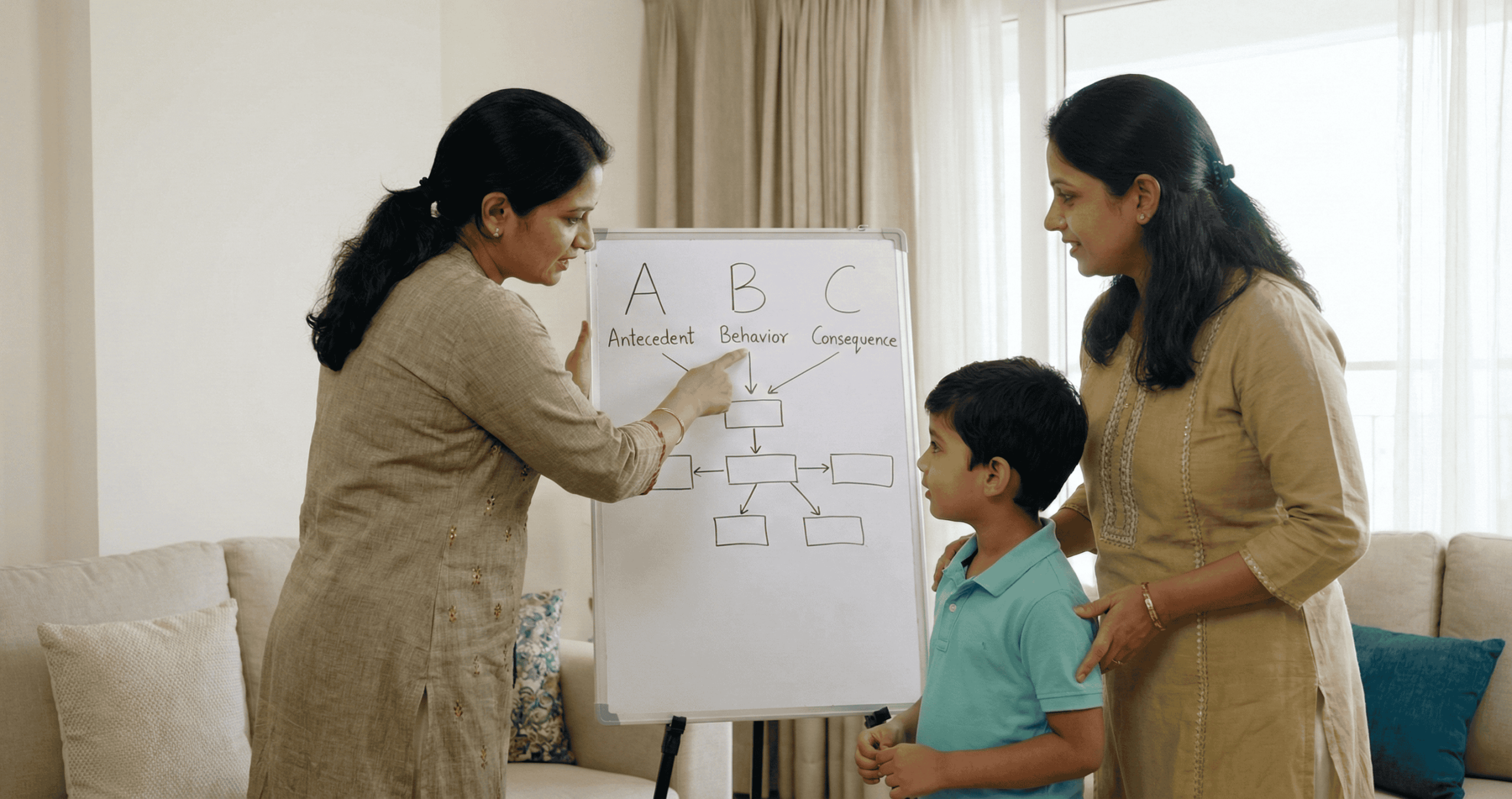
Behaviour therapy helps parents and professionals understand why a behaviour occurs and how to respond effectively. The ABC Model is a simple yet powerful framework used in Applied Behaviour Analysis (ABA) and other therapeutic settings to study and modify behaviours in a structured and scientific way.
What Is the ABC Model?
The term ABC stands for:
- A – Antecedent: What happens before the behaviour
- B – Behaviour: The action or response shown by the child
- C – Consequence: What happens after the behaviour
By observing and recording these three elements, therapists and parents can identify what triggers a behaviour and what reinforces it.
1. Antecedent: What Happens Before
The antecedent is any event, situation, or instruction that occurs right before a behaviour.
For example:
- A parent says “It’s time to stop watching cartoons.”
- The child is asked to share a toy.
- The environment becomes noisy or overwhelming.
These moments can serve as triggers that set off the behaviour. Recognising antecedents helps identify patterns — such as specific times of day, tasks, or settings — that may lead to difficulty.
2. Behaviour: What the Child Does
This refers to the child’s observable response.
Examples include crying, shouting, refusing to follow directions, running away, or sometimes even staying silent.
Recording behaviour means describing it factually, without judgement. Instead of saying “He was being stubborn,” it’s better to say “He cried and threw the toy when asked to stop playing.”
Clear descriptions help therapists and parents design effective interventions.
3. Consequence: What Happens After
Consequences determine whether a behaviour is likely to happen again.
If a child cries for a toy, and the toy is given immediately, the child learns that crying results in getting the toy. This becomes an unintentional reinforcement.
Similarly, if a child avoids a difficult task and the task is removed, the avoidance gets reinforced. On the other hand, if positive and calm behaviour is acknowledged and rewarded, that behaviour becomes stronger.
How the ABC Model Helps in Autism Therapy
The ABC framework is not about punishment or control; it is about understanding and reshaping behaviour through awareness and consistency.
Key goals include:
- Identifying triggers that cause stress or frustration.
- Recognising what the child is trying to communicate through behaviour.
- Teaching appropriate alternatives for expressing needs.
- Reinforcing positive behaviours using praise, rewards, or structured feedback.
Through observation and documentation, therapists can adjust the environment, modify tasks, or change responses to prevent challenging behaviours before they occur.
A Common Example
Let’s look at a simple example many parents relate to:
- Antecedent: The child asks for a toy at the store, and the parent says no.
- Behaviour: The child starts crying loudly.
- Consequence: The parent feels uncomfortable and gives the toy to calm the child.
In this scenario, the child learns that crying leads to getting what they want. Over time, this becomes a pattern.
To change this, the parent can use the ABC model by staying calm, acknowledging the child’s feeling (“I know you want this toy”), but maintaining the boundary (“We are not buying it today”). When the child calms down, praise that response (“Thank you for calming down; let’s look at something else”).
Gradually, the child learns that calm behaviour receives attention, not crying.
Clinical Application
Therapists use the ABC model to collect behavioural data over time. This data helps in designing Behaviour Intervention Plans (BIPs) tailored to each child’s needs.
By identifying patterns — such as sensory overload, task difficulty, or communication frustration – professionals can build structured strategies that replace unwanted behaviours with functional ones.
Behaviour therapy based on the ABC model often includes parent training, ensuring that caregivers use the same techniques at home, maintaining consistency across environments.
For Parents
For parents, it can help to start by observing and noting down a few daily situations using a simple Antecedent–Behaviour–Consequence format. For example, when the child is told to stop screen time (antecedent), the child cries loudly (behaviour), and the parent gives more time (consequence). Or when the child is asked to eat dinner (antecedent), the child throws the spoon (behaviour), and the parent replaces the food (consequence). Once patterns are visible, small changes can make a big difference — such as giving a 2-minute warning before transitions or rewarding compliance immediately.
Conclusion
The ABC Model empowers parents and therapists to see behaviour as communication, not defiance. It transforms how families understand and respond to challenging situations.
When used consistently, this model helps reduce unwanted behaviours and strengthens positive ones, allowing children to express their needs more appropriately.
Progress may take time, but every consistent, calm, and informed response helps the child learn self-regulation and confidence.
Understanding the “why” behind behaviour is the first step toward meaningful and lasting change.
This article is for educational purposes. For better accuracy, consult a Child psychologist or Autism Expert
Regards
Dr. Atul Madaan (Autism Expert)
MAAP, MBA, MPhil (Clin. Psy), PhD (Psy)
Operational Head & Clinical Psychologist- Care For Autism (CFA)
8383849217
www.autismspecialist.co.in
𝐂𝐀𝐑𝐄 𝐅𝐎𝐑 𝐀𝐔𝐓𝐈𝐒𝐌 (CFA)
One-of-a-Kind Assessment & Remedial Training Centre for Special-needs Children.
📌 Ludhiana : 114, Green Field, Kochar Market Road, Near National Lab, 9646443200
📌 Jalandhar : Hoshiarpur Road, Mubarkpur Shekhein Under Bridge, Near Railway Crossing, 9779725400
Looking for expert Autism treatment in Ludhiana and Jalandhar? At Care For Autism Dr. Atul Madaan and his team provide specialized therapies to support children with autism and developmental challenges. Our services include speech therapy, occupational therapy, child behavioral therapy, and ABA therapy for autism in a nurturing environment.
We offer psychological assessments, all type of remedial intervention. Our parent training programs empower parents and families with essential skills. If you’re searching for the best psychologist in Ludhiana, Jalandhar and Punjab, child speech therapy, or a child development center, we are here to help!
Visit our centres in Ludhiana and Jalandhar for autism therapy, parental training, and educational assessments. Give your child the best support with expert care.
Leave a Reply